Follow this link to skip to the main content
Jet Propulsion Laboratory
+ View the NASA Portal
Go!
JPL Home JPL Home Page - Earth JPL Home Page - Solar System JPL Home Page - Stars and Galaxies JPL Home Page - Technology
Cassini-Huygens: Mission to Saturn and Titan Cassini-Huygens: Mission to Saturn and Titan
California Institute of Technology Jet Propulsion Labaoratory NASA
For News Media
For Planetariums & More
For Educators
For Kids
Home
Overview
Multimedia
Cassini at Saturn
Mission
Spacecraft
Science
SPACECRAFT - Introduction

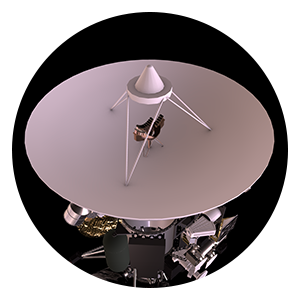
Cassini-Huygens spacecraft
Cassini-Huygens Spacecraft
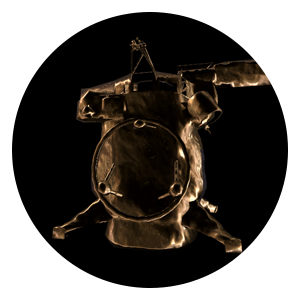
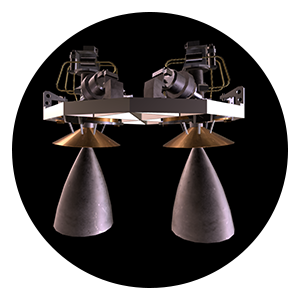
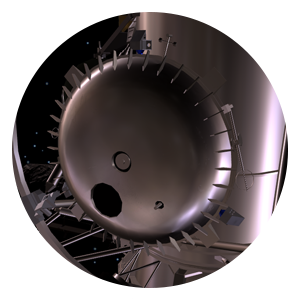
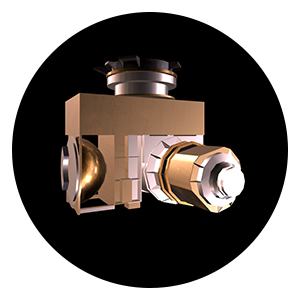
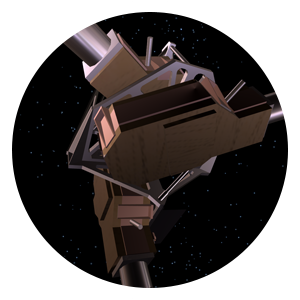
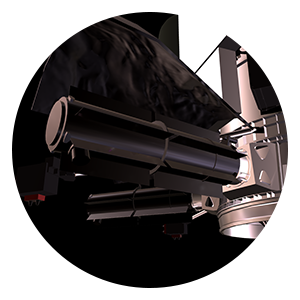
Components details

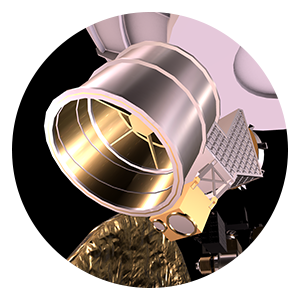
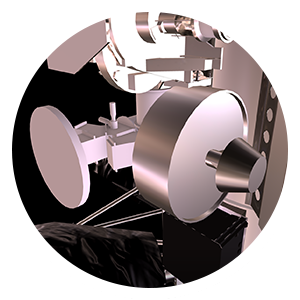
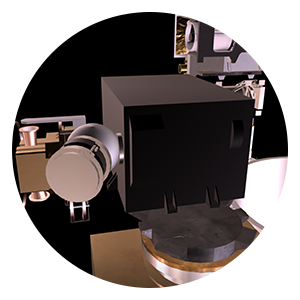
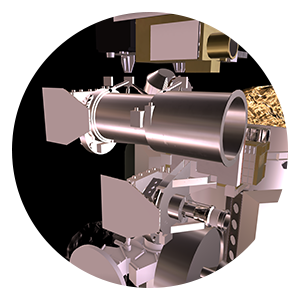
Cassini-Huygens is one of the most ambitious missions ever launched into space. Loaded with an array of powerful instruments and cameras, the spacecraft is capable of taking accurate measurements and detailed images in a variety of atmospheric conditions and light spectra.

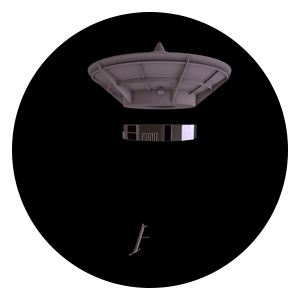
Two elements comprise the spacecraft: The Cassini orbiter and the Huygens probe. In 2004, Cassini-Huygens reached Saturn and its moons. There the spacecraft has begun to orbit around the system for four years, beaming home valuable data that will help us understand the vast Saturnian region. Huygens entered the murky atmosphere of Titan, Saturn's biggest moon, and descended via parachute onto its surface.

Cassini-Huygens is a three-axis stabilized spacecraft equipped for 27 diverse science investigations. The Cassini orbiter has 12 instruments and the Huygens probe had six. The instruments often have multiple functions, equipped to thoroughly investigate all the important elements that the Saturn system may uncover. The spacecraft communicates through one high-gain and two-low gain antennas. It is only in the event of a power failure or other such emergency situation, however, that the spacecraft will communicate through one of its low-gain antennas, known as LGA-1.

Three Radioisotope Thermoelectric Generators -- commonly referred to as RTGs -- provide power for the spacecraft, including the instruments, computers, and radio transmitters on board, attitude thrusters, and reaction wheels.

Cassini spacecraft with "almost human" features
Cassini-Huygens Spacecraft with "almost human" features

In some ways, the Cassini spacecraft has senses better than our own. For example, Cassini can "see" in wavelengths of light and energy that the human eye cannot. The instruments on the spacecraft can "feel" things about magnetic fields and tiny dust particles that no human hand could detect.

The science instruments can be classified in a way that can be compared to the way human senses operate. Your eyes and ears are "remote sensing" devices because you can receive information from remote objects without being in direct contact with them. Your senses of touch and taste are "direct sensing" devices. Your nose can be construed as either a remote or direct sensing device. You can certainly smell the apple pie across the room without having your nose in direct contact with it, but the molecules carrying the scent do have to make direct contact with your sinuses. Cassini's instruments can be classified as remote and microwave remote sensing instruments, and fields and particles instruments--these are all designed to record significant data and take a variety of close-up measurements.

The remote sensing instruments on the Cassini Spacecraft can calculate measurements from a great distance. This set includes both optical and microwave sensing instruments including cameras, spectrometers, radar and radio.

The fields and particles instruments take "in situ" (on site) direct sensing measurements of the environment around the spacecraft. These instruments measure magnetic fields, mass, electrical charges and densities of atomic particles. They also measure the quantity and composition of dust particles, the strengths of plasma (electrically charged gas), and radio waves.

At a Glance
  • Dimensions: 6.7 meters (22 feet) high; 4 meters (13.1 feet) wide
  • Weight: 5,712 kilograms (12,593 pounds) with fuel, Huygens probe, adapter, etc; 2,125
  • kilograms (4,685 pounds) unfueled orbiter alone
  • Orbiter science instruments: composite infrared spectrometer, imaging system, ultraviolet imaging spectrograph, visual and infrared mapping spectrometer, imaging radar, radio science, plasma spectrometer, cosmic dust analyzer, ion and neutral mass spectrometer, magnetometer, magnetospheric imaging instrument, radio and plasma wave science
  • Power: 885 watts (633 watts at end of mission) from radioisotope thermoelectric generators

Privacy Statement Glossary Sitemap FAQ
FirstGov NASA
Outreach Manager: Alice Wessen
Editor: Kirk Munsell
Science Writer: Enrico Piazza
Webmaster: Allan Yu.
Last Updated: 05.11.2007
JPL Clearance: CL02-2452
+ Contact Us