Follow this link to skip to the main content
Jet Propulsion Laboratory
+ View the NASA Portal
Go!
JPL Home JPL Home Page - Earth JPL Home Page - Solar System JPL Home Page - Stars and Galaxies JPL Home Page - Technology
Cassini-Huygens: Mission to Saturn and Titan Cassini-Huygens: Mission to Saturn and Titan
California Institute of Technology Jet Propulsion Labaoratory NASA
For News Media
For Planetariums & More
For Educators
For Kids
Home
Overview
Multimedia
Cassini at Saturn
Mission
Spacecraft
Science
CASSINI AT SATURN - Introduction

Artist's View of Cassini approaching Saturn

On July 1, 2004 UTC, the Cassini-Huygens spacecraft fired its main engine to reduce its speed, allowing the spacecraft to be captured by Saturn's gravity and enter orbit. The spacecraft is now on a four-year mission to explore the ringed planet, its mysterious moons, the stunning rings and its complex magnetic environment.

During the Saturn Tour, Cassini will complete 74 orbits of the ringed planet, 44 close flybys of the hazy moon Titan, and numerous flybys of Saturn's other icy moons. For detailed list of events, see Saturn Tour Dates.


2008 Saturn Tour Highlights:
(Dates listed in Spacecraft Event Time [SCET] -- the time the something happens at the spacecraft based on Coordinated Universal Time [UTC]. See Living on Saturn Time)

Jan. 5, 2008: Titan flyby (T40) -- the Visual and Infrared Mapping Spectrometer (VIMS) maps the Huygens landing site with a highly illuminated surface. This flyby features two separate stellar occultations to study the structure of Titan's atmosphere. VIMS watches the star Alpha Bootes, and the Ultraviolet Imaging Spectrograph (UVIS) watches Alpha Lyra.

Feb. 22, 2008: Titan flyby (T41) -- features a RADAR Synthetic Aperture Radar Imager (SAR) swath of Titan's southeast quadrant and the Huygens landing site. This flyby also has the mission's "longest" stellar occultation of Titan's atmosphere, occurring about a day after closest approach.

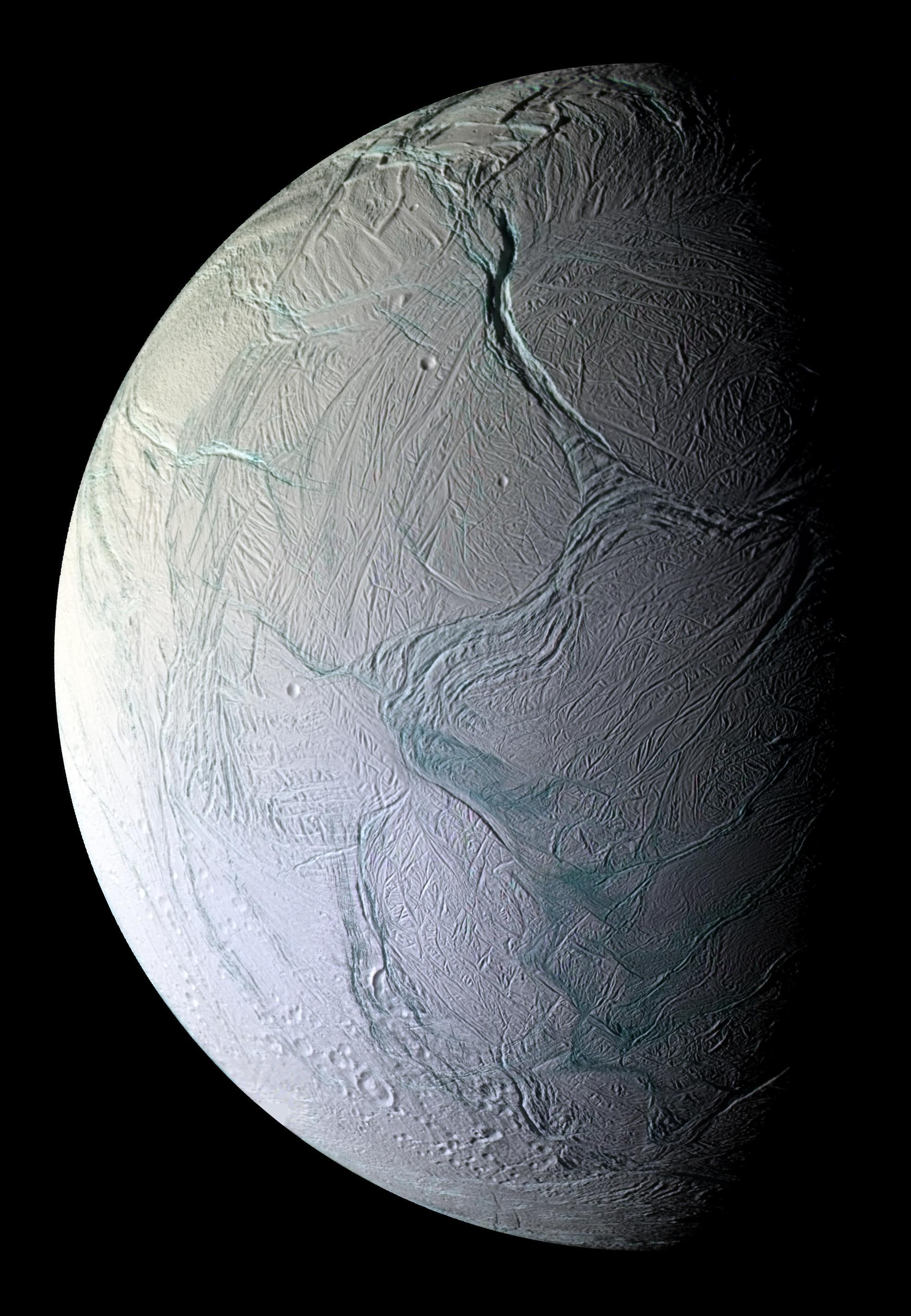
March 12, 2008: Enceladus flyby -- This is the third and final targeted flyby of Enceladus in the prime mission. It is an inclined flyby with a closest approach distance near the equator of about 50 kilometers, enabling the first good views of the northern hemisphere. The trajectory will take Cassini through the plume at a grazing angle (deeper into the plume than during the July 2005 flyby), allowing for fields-and-particles measurements within the plume. Enceladus will enter eclipse (Saturn's shadow) shortly after closest approach, allowing for thermal measurements of the south pole at high resolution.

March 25, 2008: Titan flyby (T42) -- it is "High Noon" for Cassini during this encounter, with the Sun high in Titan's sky. Just prior to closest approach, the Ion and Neutral Mass Spectrometer (INMS) examines Titan's upper atmosphere. Immediately after closest approach, VIMS captures high resolution imaging of the probe landing site.

May 12, 2008: Titan flyby (T43) -- RADAR captures SAR imaging of Titan's bright region known as Xanadu. The only other RADAR coverage of this area was back in April 2006 (T13).

May 28, 2008: Titan flyby (T44) -- this unique and highly important flyby features a RADAR pass across Xanadu, making T44 and T43 coverage of the area the only RADAR pass other than the T13 flyby (in April 2006).

June through August 2008: The Cassini spacecraft enters the highest inclination orbits of the tour. In these high inclined orbits scientists will have their best opportunities to use Stellar Occultations to penetrate the B ring. And the spacecraft will be able to show views of Saturn as no one has seen it before! The rings will be spread out like a giant halo around Saturn.

These high inclined orbits also present the Magnetosphere and Plasma Science (MAPS) scientists with many science opportunities that have been long awaited.

June 30, 2008: End of Prime Mission.

Extended Mission beginning in July 2008 will be known as the Cassini Equinox Mission.

July 31, 2008: Titan flyby (T45) -- Radio Science Subsystem (RSS) uses this pass to measure Titan's gravity field, allowing us to explore the moon's interior. This is the fourth of four fly-bys needed to determine if Titan has an internal ocean.

Aug. 11, 2008: Enceladus flyby -- This is the first targeted flyby of Enceladus in the Extended Mission. The flyby geometry is very similar to that of the March 2008 flyby, however the spacecraft will be oriented to optimize the flyby for viewing by cameras and spectrometers, to obtain the highest resolution views of the active south pole region.

Oct. 9, 2008: Enceladus flyby -- This is the second of seven targeted Enceladus fly-bys in the Extended Mission. The flyby geometry is very similar to that of the March 2008 flyby: an inclined trajectory allowing Cassini to pass through the plumes for fields-and-particles measurements near closest approach.

Oct. 31, 2008: Enceladus flyby -- This is the final inclined flyby of Enceladus, and at about 200 kilometers, is more distant than the earlier fly-bys in the year. This flyby will be dedicated to remote sensing measurements by cameras and spectrometers, to obtain images as well as compositional and thermal information on the north and south pole regions.

Nov. 3, 2008: Titan flyby (T46) -- Radio Science watches as the Earth slips behind Titan, using the spacecraft's signal to probe Titan's atmosphere in the north mid latitude, with the occultation at 26 degrees North. In another RSS experiment, a signal is bounced off of Titan's surface and then returned to Earth.

Nov. 19, 2008: Titan flyby (T47) -- VIMS observes the Huygens probe landing site, and UVIS observes a star (Beta Cma) through Titan's atmosphere, using the star as a "flashlight" to study Titan's atmospheric structure and composition. This is one of the best "low phase" fly-bys for the VIMS instrument in the extended mission.

Dec. 5, 2008: Titan flyby (T48) -- Cassini swoops down to 960 kilometers (about 580 miles) over Titan's surface. The Ion and Neutral Mass Spectrometer (INMS) takes advantage of this low altitude, sampling Titan's ionosphere on the dayside. In fact, this is the best dayside pass for INMS during the extended mission. RADAR gets to capture a SAR swath over the Tui Regio area of Xanadu, a very bright feature in VIMS observations.

Dec. 21, 2008: Titan flyby (T49) -- Closing out the year, RADAR will carry out altimetry observations over the area known as Ontario Lacus, in Titan's Southern hemisphere.

Dec. 26, 2008: 100th orbit periapsis.

Read previous years' highlights.

Privacy Statement Glossary Sitemap FAQ
FirstGov NASA
Outreach Manager: Alice Wessen
Editor: Kirk Munsell
Science Writer: Enrico Piazza
Webmaster: Allan Yu.
Last Updated: 05.06.2008
JPL Clearance: CL02-2452
+ Contact Us